Summary:
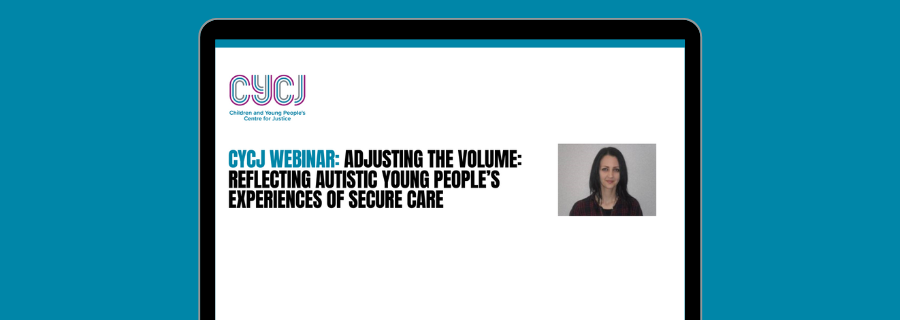
In this webinar, Charlotte will present the findings of her PhD research project. This research explored the impact of secure care on the identity narratives of autistic young people. It made use of a flexible diary method and semi-structured interviews, analysed using Interpretative Phenomenological Analysis (IPA) to seek reflections on the experiences of autistic young people who were living, or had recently lived, in Scotland’s secure care accommodation services. By listening directly to young people, this research offers a unique contribution to knowledge about life for a group of young people often described as ‘hard to reach’. It considers the intersection of both autism and secure care through the lenses of relationships, residence, and rules. Due to the ambivalence, incongruence and dissonance experienced by young people, it proposes that there is the potential for secure care to create barriers or supports, in relation to communication and attachment (through relationships); sensory differences (through the residence); and need for structure and routine (through the rules). In considering what is already known about autism in restricted settings such as secure care, it makes a number of recommendations for future practice, including in relation to congruent communication; ambivalent experiences; belonging; hyper-empathy; symbolism; environmental adaptations; masking; sensory connectivity; dichotomous thinking; information sharing; the autistic experience; and individuality of risk management.
Bio:
With a background in residential child care, Charlotte Wilson is currently employed by the Care Inspectorate with responsibility for regulated children and young people’s services. Separately to her employed role, she has been undertaking a PhD in social work, exploring autistic young people’s experiences of secure care in Scotland.
Download the presentation slides here
Links shared during this webinar:
- Wilson, C. (2016). You tell me what we can do after this: Findings and recommendations for the participation of young people with learning disabilities. Scottish Journal of Residential Child Care, 15(2), 8-28.
- Wilson, C. (2022). A brief history of secure care in Scotland. Scottish Journal of Residential Child Care, 21(2). https://www.celcis.org/application/files/7416/6793/8118/2022_Vol_21_No_2_Wilson_C_A_brief_history_of_secure_care_in_Scotland.pdf
- Wilson, C. (2024). Adjusting the volume: Reflections on engagement with autistic young people living in secure care. Scottish Journal of Residential Child Care, 23(2). https://doi.org/10.17868/strath.00091142
- To keep up to date on all CYCJ events, you can sign up for our monthly e-bulletin here – http://eepurl.com/dvyBuv
- Future webinars – https://www.tickettailor.com/events/childrensandyoungpeoplescentreforjustice
- CYCJ has a brand new e-Learning platform! Click here to find out more
- Practice Chapter https://www.cycj.org.uk/wp-content/uploads/2025/07/Section-8-Mental-Health-and-Neurodiversity.pdf