The Challenging Justice Inequalities with Children in Conflict with the Law project was conducted by the Children and Young People’s Centre for Justice (CYCJ), researchers from the University of Strathclyde’s Schools of Law and Education and from the Centre for Excellence for Children’s Care and Protection (CELCIS). The project focused on children under 18 in Scotland who encounter justice systems as a result of offending behaviour.
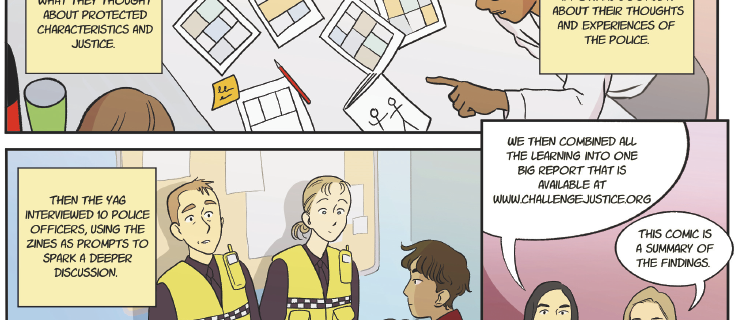
The research was co-produced with a Youth Advisory Group (YAG) comprising nine children aged 14-17 with experience of being in conflict with the law and was funded by the Nuffield Foundation. The project began with exploratory focus groups, and the recruitment of a YAG. The YAG then engaged with children and police officers, using creative methods such as zine-making to explore children’s experiences in a safe and accessible way. Police officers were shown the zines as part of their interviews to spark reflective and more personal responses.
The research aimed to address a lack of evidence about how protected characteristics can shape the experiences of children in conflict with the law, and how these experiences can affect their interactions with the justice system. A key aim of the project was to address these gaps by involving children directly in the research process. The YAG played a central role in designing and delivering the research, helping to ensure that children’s views and experiences informed the study throughout, and supporting the YAG’s growth and development as co-researchers.
The research found that age was often a defining feature of children’s intersectional justice experiences. Many children who took part in this research believed that age intersected with numerous other characteristics to amplify and intensify their differential treatment, for example, through being excluded from public spaces, both formally through bans (e.g. being denied entry to fast food restaurants) or informally from feeling overtly surveilled.
Children reported that they had faced bias and stereotyping from protected characteristics such as race and gender. But the research also identified a number of other ‘missing’ characteristics that drew the attention of the police, including where they live or spend time, appearance, care experience, prior contact with police, and family history. Discussions on place (i.e. certain neighbourhoods) and appearance implicitly touched on class and socioeconomic status. One research participant said: “They just assume we are doing bad things. It’s based on portrayal in the media and public perception of groups.”
The findings highlight that despite it often being necessary to treat children differently due to their age and developmental stage, this must be done in a way that does not result in detrimental age-based stereotypes, in the same way as would be seen as unacceptable for adults. It also points to the limitations of the existing Equality Act in adequately protecting children from age-based discrimination, or in helping understand intersectional justice. At a time of increasing Police powers to further exclude and isolate children, it is hoped that this report will highlight who is disproportionately impacted by such policies, and spark reflection on the hidden biases that may have influenced their development. Importantly, the report also makes a number of recommendations for policymakers and practitioners in the police, education, support organisations and other justice settings.
Dr Nina Vaswani, Principal Investigator on the project, said: “This research highlights how an intersectional lens reveals previously hidden complexities and nuances in children’s experiences of justice. Children reported feeling both overlooked and dismissed, while also being overpoliced and over-surveilled, often linked to aspects of their identity. Encouragingly, both children and police officers identified opportunities for positive change, providing hope for improved relationships between children and police in the future.”
Ash Patel, Programme Head at the Nuffield Foundation said, “This research shows that inconsistent treatment within the justice system is letting children down. Action is needed to ensure children and young people feel less victimised because of their identities, characteristics and circumstances, and are seen and heard when they need support. Although focused on children’s experiences, the research also created space for dialogue between police officers and young people, improving understanding of the demands and challenges frontline officers face. It shows that better engagement may help build more constructive and trusting relationships between police and young people”
The suite of research outputs, including the research report, summary report, a film, comic and a library of zines created by research participants are available by clicking here.
The Funder
The Nuffield Foundation is an independent charitable trust with a mission to advance social well-being. It funds and undertakes rigorous research, encourages innovation and supports the use of sound evidence to inform social and economic policy, and improve people’s lives. The Nuffield Foundation is the founder and co-funder of the Nuffield Council on Bioethics, the Ada Lovelace Institute and the Nuffield Family Justice Observatory. This project has been funded by the Nuffield Foundation, but the views expressed are those of the authors and not necessarily the Foundation. Find out more at: www.nuffieldfoundation.org. Bluesky: @nuffieldfoundation.org, LinkedIn: Nuffield Foundation