Summary:
Harmful Sexual Behaviour (HSB) displayed by children and young people is a deeply distressing social issue. In the UK it is estimated that around one-third of sexual abuse of a child is committed by another child under 18 (Hackett et al., 2019). In Scotland, the number of cases of sexual offences against a child by a child (under 18), between 2012-2016, rose by 34% with 96% perpetrated by males (Scottish Government, 2020). Tracing the socio-historical constructions of HSB reveals how dominant paradigms shape the ways we think about child sexual abuse and adult offending which created pervasive legacies on children and childhood. These paradigms created liminal conceptual shadows where young people who display HSB came to be seen like ‘mini-adult sex offenders’, neglecting their developmental, social, and contextual realities. Policy, practice and research, whilst evolving, still often rely on models and understandings that are rooted in research with adults and criminology that fail to recognise the complexities of childhood. There is growing evidence of shifting paradigms moving away from individual and risk focussed understanding towards more contextual, ecological and developmentally sensitive knowledge.
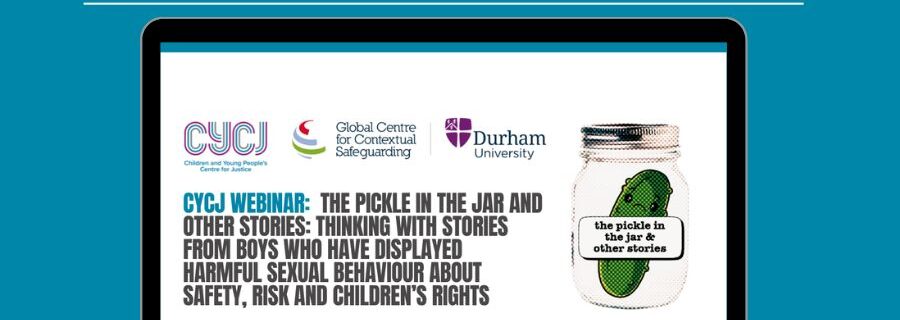
In this webinar, Dr Lynne Cairns shared stories from boys and practitioners gathered in her PhD to understand more about the social, spatial and relational dimensions of risk, safety and children’s rights. She began by reflecting on her own story from practice to PhD in Scotland before reflecting upon the landscape of knowledge around HSB and the contours of Scottish police landscape which create opportunities to look differently at this complex and distressing social issue. Through child-sensitive and rights-respecting research design, the study engages four young people and four practitioners over multiple sessions, through creative mediums including immersive Virtual Reality (VR) technology to traverse space and time, revealing storied experiences embedded in places. Brought to life by stories, Lynne shared her conceptualisations of ‘lifescapes’ – landscapes of life – to reflect easily overlooked aspects of everyday life that appear as significant to safety, risk and rights. Together, we toured these ‘lifescapes’ starting with informal spaces including ‘public’ places, ‘private’ bedrooms and digital social worlds before travelling through more institutional spaces of schools and the ‘care system’. One participant’s poignant story of a lonely, rotten pickle in a jar evokes curiosity around the legacies of systemic and practice responses on developing lives and the stories our systems tell to and about young people through our system responses.
The webinar concluded by translating these insights into practical learning for professionals working with children and young people who display HSB. It explored:
- How young people’s stories challenge dominant risk-centred practices and the importance of considerations of safety and children’s rights alongside risk management and reduction.
- What young people’s stories reveal about how we conceptualise and perform ’risk work’, including the language we use and its impact on young people’s identities, experiences of their social worlds and their futures.
- Ways through which practitioners can reorient their responses towards safety-building, contextual understanding and relationships.
- How risk assessment, management and reduction can better reflect the tempos, rhythms and spaces of everyday life, rather than abstract or anxious responses.
- How the UNCRC can serve as a conductor – positioning practitioners and multi-agency teams around the child like an orchestra of duty bearers – to inform more rights-based, future-focused responses to HSB.
- Key UNCRC articles relevant to HSB and related practical resources to support practitioners to make rights tangible, accessible and actionable in everyday practice.
Bio:
Dr Lynne Cairns is Post Doctoral Research Associate in the Global Centre for Contextual Safeguarding at Durham University working on various projects including ‘From Capacity to Context’ project with welfare-involved parents of adolescents and practitioners to shift the focus from parenting capacity to the contexts of parent’s lives. Before joining the team in 2025, Lynne completed an ESRC-funded PhD, exploring everyday life with teenage boys who have displayed harmful sexual behaviour (HSB) to consider social and spatial dimensions of safety, risk and children’s rights.
Lynne has been a social worker for 25 years, qualifying with an MA (Honours) in Social Work from University of Dundee then subsequent postgraduate training in Child Protection (University of Dundee), PG Diploma in Counselling and Psychotherapy (University of Stirling) and an MSc with distinction in Psychoanalytic Observation and Reflective Practice (University of Strathclyde). Lynne has worked in a range of practice settings including secure and residential childcare and over 13 years as a senior practitioner with children and young people who experienced abuse and/or displayed HSB.
Lynne is particularly interested in interdisciplinary, intergenerational and rights-based approaches to prevent harm, including how systems can help or hinder safety and wellbeing. Lynne is a founding member of an international, interdisciplinary working group on child-focused cities, developed through the Swedish International Centre for Local Democracy, reflecting a commitment to building safer, more inclusive environments for children, young people, families and communities.
[Trigger warning: This webinar will discussed harmful sexual behaviour, child sexual abuse and other forms of harm that impact children, young people, families and communities. These are complex, distressing and sensitive social issues. These issues can be difficult to think about and may resonate with personal or professional experiences.]
Follow up resource (including slides):
CYCJ webinar Lynne Cairns (follow up references)
Useful links:
CYCJ Webinars – CYCJ’s upcoming webinars.
CYCJ E-bulletin – Sign up to receive our e-bulletin
CYCJ has a new e-Learning platform! Click here to find out more.
New module on “The Children (Care and Justice) (Scotland) Act 2024- What you need to know” out now: Children’s (Care and Justice) (Scotland) Act 2024 – What you need to know
National Youth Justice Conference tickets available now: https://www.cycj.org.uk/event/national-youth-justice-conference-2026/